


Brandi Kelly
Bookkeeper & Managing Partner
Brandi is an experienced bookkeeper with 5+ years in the industry and a strong background in QuickBooks Online. After spending more than two decades in the food and beverage world-where she gained firsthand experience supporting business operations and bookkeeping-she built her first firm, Golden Rule Bookkeeping, with the goal of creating a client-first service rooted in integrity and clear communication. Brandi later partnered with Hopkins CPA Firm to form NIB, combining dependable bookkeeping systems with CPA-level insight to help business owners feel confident in their numbers. Known for her fast, friendly communication and commitment to clean, accurate books, Brandi is passionate about giving clients the freedom to focus on running their business while she ensures their financials are organized, reliable, and ready for smart decision-making year-round.

Our Blogs

difference between a bookkeeper and accountant

If you’re wondering about the difference between a bookkeeper and an accountant, then read this guide. Both help manage your business finances, but they have different roles. A bookkeeper records daily financial transactions, while an accountant reviews that information to prepare reports, manage taxes, and provide financial advice.

Understanding what is the difference between a bookkeeper and an accountant helps you choose the right professional for your business. Whether you need help keeping your records organized or making important financial decisions, knowing the difference makes it easier to find the right support.

Key Takeaways

  • Bookkeepers and accountants have different responsibilities. Bookkeepers record and organize daily financial transactions, while accountants analyze those records to provide financial reports, tax planning, and business advice.
  • The right choice depends on your business needs. Hire a bookkeeper to manage day-to-day financial records and an accountant when you need strategic financial guidance, tax support, or compliance assistance.
  • Education and expertise differ. Bookkeepers typically learn through practical experience and bookkeeping training, while accountants usually hold accounting degrees and may have professional certifications such as a CPA.
  • Many businesses benefit from using both professionals together. Accurate bookkeeping provides the reliable financial data accountants need for reporting, forecasting, and informed decision-making.
  • Consistent bookkeeping throughout the year improves financial accuracy, simplifies tax preparation, and helps business owners make confident, data-driven decisions.

What Does a Bookkeeper Do?

A bookkeeper keeps your financial records accurate, organized, and up to date. Their main role is to record daily transactions so you always know your income, expenses, and cash flow. When looking at the difference between a bookkeeper and an accountant, the bookkeeper is responsible for maintaining your financial records regularly.

Common bookkeeping tasks include:

  • Recording sales, expenses, bills, and payments
  • Creating and tracking invoices
  • Managing accounts payable and accounts receivable
  • Reconciling bank and credit card statements
  • Organizing receipts and financial documents
  • Keeping the general ledger accurate and up to date

In simple terms, the difference between a bookkeeper and an accountant is that a bookkeeper records your financial information, while an accountant uses those records for reporting, taxes, and financial planning.

Explore: Common Bookkeeping Mistakes Small Businesses Must Avoid 

What Does an Accountant Do?

An accountant reviews and analyzes your financial records to help you understand your business performance. They use the information prepared by your bookkeeper to create reports, manage taxes, and provide financial advice. In the difference between a bookkeeper and an accountant, an accountant focuses on analysis and planning rather than daily recordkeeping.

Common accounting tasks include:

  • Preparing financial statements and reports
  • Reviewing bookkeeping records for accuracy
  • Assisting with tax planning and tax filings
  • Creating budgets and financial forecasts
  • Supporting audits, loans, and investor reporting
  • Providing financial advice to improve business performance

In simple terms, what is the difference between a bookkeeper and an accountant? A bookkeeper records your financial data, while an accountant uses that data to help you make informed business decisions.

Key Differences Between a Bookkeeper and Accountant

The difference between a bookkeeper and an accountant usually comes down to education, scope, and how their work is used. Both are valuable, but they solve different problems.

AreaBookkeeperAccountant
Primary FocusRecords daily financial transactions and keeps books up to dateAnalyzes financial data and provides business and tax advice
TimingDaily, weekly, or monthlyMonthly, quarterly, yearly, or as needed
OutputClean ledgers, reconciled accounts, and organized financial recordsFinancial statements, analysis, forecasts, and tax planning
Typical Business NeedAccurate day-to-day bookkeeping and recordkeepingFinancial strategy, compliance, and higher-level reporting

Education and Certifications

Education is one of the main differences between a bookkeeper and an accountant. Bookkeepers usually learn through practical experience and bookkeeping courses, while accountants typically have a degree in accounting or finance. Some accountants also earn a CPA license to provide advanced financial and tax services.

Key Differences:

  • Bookkeepers: Bookkeeping training, hands-on experience, and optional bookkeeping certifications
  • Accountants: Accounting or finance degree, advanced technical knowledge, and possible CPA certification

Scope of Work

Bookkeepers focus on recording daily financial transactions and handling routine accounting tasks. Accountants take this information further by reviewing it, applying accounting principles, and using it to understand business performance and plan ahead.

In simple terms, when asking what the difference is between a bookkeeper and an accountant, bookkeeping is about what happened, while accounting is about what it means and what to do next.

Tools and Software Used

Bookkeepers and accountants often use similar software, but they use it differently. Bookkeepers mainly use tools like QuickBooks Online to record transactions, send invoices, and reconcile accounts. Accountants use the same systems but focus more on reports, adjustments, analysis, and financial planning.

Common tools include:

  • Bookkeeping systems: Transaction recording, invoicing, and bank reconciliation tools
  • Accounting systems: Financial reporting, analysis, forecasting, and statement preparation
  • Supporting tools: Receipt capture apps, payroll software, and budgeting dashboards

When to Hire a Bookkeeper vs an Accountant

Choosing the right support depends on your business needs. If your financial records are messy or not updated regularly, the difference between a bookkeeper and an accountant becomes important because a bookkeeper helps get your day-to-day records back on track.

You may need a bookkeeper if you:

  • Can’t keep up with daily or monthly transaction entry
  • Need regular reconciliations and organized records
  • Want accurate monthly financial reports
  • Need help with invoicing, bills, or payroll tasks

You may need an accountant if you:

  • Need tax planning or advice on tax impact
  • Want budgeting, forecasting, or financial strategy
  • Require lender-ready or investor-ready reports
  • Have complex compliance or reporting needs

In many cases, businesses use both together a bookkeeper for daily accuracy and an accountant for higher-level financial guidance.

Explore: Benefits of Hiring a Bookkeeper for Your Business 

Common Misconceptions
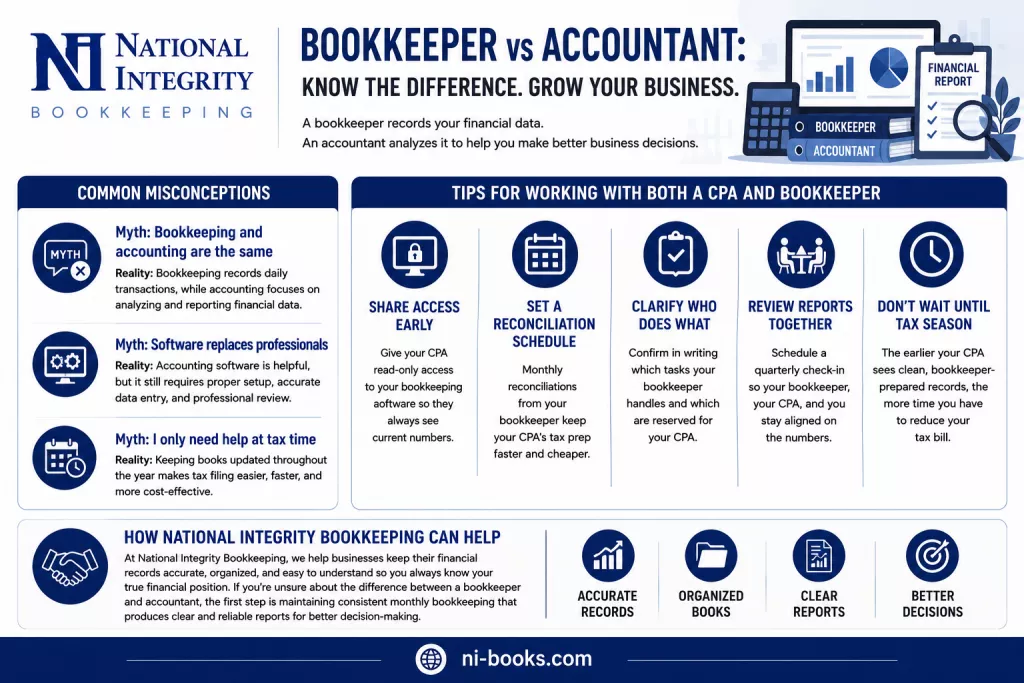
Many people misunderstand the difference between a bookkeeper and an accountant because of a few common myths:

  • Myth: Bookkeeping and accounting are the same
    Reality: Bookkeeping records daily transactions, while accounting focuses on analyzing and reporting financial data.
  • Myth: Software replaces professionals
    Reality: Accounting software is helpful, but it still requires proper setup, accurate data entry, and professional review.
  • Myth: I only need help at tax time
    Reality: Keeping books updated throughout the year makes tax filing easier, faster, and more cost-effective.

How National Integrity Bookkeeping Can Help

At National Integrity Bookkeeping, we help businesses keep their financial records accurate, organized, and easy to understand so you always know your true financial position. If you’re unsure about the difference between a bookkeeper and accountant, the first step is maintaining consistent monthly bookkeeping that produces clear and reliable reports for better decision-making. 

Explore services based on what you need:

Choosing the Right Professional for Your Business

To choose the right support, start with your main challenge. If your financial records are not updated, hire a bookkeeper to handle daily transactions and keep records maintained. If your records are already in place but you need guidance, an accountant can help with tax planning, financial advice, and business insights. If your business is growing quickly, it often works best to use both a bookkeeper for daily work and an accountant for review and planning.

In simple terms, the difference between a bookkeeper and accountant is that bookkeeping focuses on recording daily financial activity, while accounting focuses on interpreting those numbers and using them to support better business decisions.

Conclusion

The difference between a bookkeeper and accountant is simple: bookkeepers record and manage your financial activity, while accountants review that information to create reports, insights, and financial guidance. When both roles work together, you get better clarity, smoother reporting, and stronger business decisions.

At National Integrity Bookkeeping, we help you maintain clear and consistent financial records so your accountant can focus on strategy and tax planning. Get in touch with us to keep your books on track and your business moving forward with confidence.

FAQs

A bookkeeper records daily transactions, while an accountant reviews and analyzes those records to prepare reports and guide business decisions.

Bookkeepers can handle basic reporting, but most accounting work, like detailed analysis, tax planning, and financial strategy, is done by an accountant.

Yes, many small businesses use both. A bookkeeper manages daily records, and an accountant helps with taxes and financial planning.

Bookkeepers usually cost less because they handle routine work. Accountants cost more due to their advanced skills and qualifications.

If you need help with daily records, hire a bookkeeper. If you need tax advice, planning, or financial insights, hire an accountant.


bookkeeping for cleaning business

Good bookkeeping for cleaning business owners helps make pricing, hiring, and growth decisions easier. When your financial records are accurate and updated regularly, you can clearly track income, expenses, payroll, and job profitability without guessing where your money is going.

This guide explains the basics of bookkeeping for cleaning business, including how to manage invoices, payroll, expenses, and financial reports. You’ll also learn important cleaning services bookkeeping practices that help cleaning companies handle recurring schedules, labor costs, and supply expenses more effectively.

Why Bookkeeping for Cleaning Business Matters From Day One

Bookkeeping for cleaning business owners matters from day one because small financial mistakes can turn into bigger problems over time. Missing receipts, wrong expense categories, or late invoices can lead to inaccurate reports and make it harder to manage pricing, hiring, and daily business decisions.

Good cleaning services bookkeeping helps track profitable services, control payroll and supply costs, and manage unpaid invoices more easily. Since cleaning businesses often deal with regular payroll, fuel expenses, cleaning supplies, and recurring customers, following a simple weekly bookkeeping routine can improve cash flow and keep financial records organized and accurate.

Set Up Your Cleaning Services Bookkeeping the Right Way

A simple and reliable setup makes bookkeeping for cleaning business owners much easier to manage. The goal is to create a system that is easy to follow every week and helps keep financial records accurate.

  • Open separate business bank and credit card accounts
  • Use one bookkeeping software for invoices, expense tracking, and reports
  • Create clear categories for supplies, payroll, equipment, fuel, insurance, marketing, and office expenses
  • Save receipts and vendor bills for every business expense

Most small businesses use cash-based cleaning services bookkeeping, which means income and expenses are recorded when money is received or paid. Keeping the process simple and consistent helps maintain accurate records and makes bookkeeping easier to manage.

Track Income, Recurring Jobs, and One-Time Cleaning Revenue

In bookkeeping for cleaning business, tracking income properly helps you understand where your revenue is coming from and which services are most profitable. This is especially important for businesses that manage both recurring cleaning services and one-time jobs.

To keep reports clear and useful, separate income by service type, such as:

  • Recurring residential cleaning
  • Deep cleaning
  • Move-in / move-out cleaning
  • Commercial cleaning contracts
  • Extra add-on services

Good cleaning services bookkeeping also includes tracking tips, deposits, discounts, and sales tax correctly. When income is properly organized, cleaning businesses can better understand profits, adjust pricing, and focus on the services that make the most money.

Also Read: Bookkeeping Services for Small Businesses 

Record Supplies, Mileage, Payroll, and Other Daily Expenses

Accurate expense tracking is an important part of bookkeeping for cleaning business owners because cleaning companies manage regular labor, supply, and vehicle costs. Small expenses can add up quickly, so keeping records updated helps improve cash flow and profitability.

Important expense categories to track include:

  • Cleaning supplies and paper products
  • Equipment purchases and repairs
  • Fuel, mileage, parking, and vehicle expenses
  • Payroll, bonuses, and contractor payments
  • Insurance, permits, and compliance costs
  • Marketing, software, and payment processing fees

Good cleaning services bookkeeping also includes saving receipts and updating mileage records regularly. Simple habits like uploading receipts immediately and reviewing expenses weekly can help keep financial records accurate and easier to manage.

Manage Invoices, Late Payments, and Cash Flow Without Confusion

In bookkeeping for cleaning business, steady cash flow depends on sending invoices on time and following up on unpaid payments regularly. Many cash flow problems happen because invoices are delayed, payment terms are unclear, or overdue accounts are not reviewed consistently.

A simple invoicing routine can help:

  • Send invoices immediately after service or on a fixed weekly schedule
  • Use clear payment terms and keep them consistent
  • Turn on automatic payment reminders
  • Review unpaid invoices every week

Good cleaning services bookkeeping also means tracking upcoming payroll, recurring bills, supply purchases, and expected customer payments. Reviewing cash flow weekly helps cleaning businesses avoid payment gaps and stay financially prepared for upcoming expenses.

Explore: What are Bookkeeping Services for Businesses 

Read the Reports That Show If Your Cleaning Business Is Making Money

In bookkeeping for cleaning business, financial reports help you understand whether your business is truly profitable. Once your transactions are updated and accounts are reconciled, these reports can help you track income, expenses, unpaid invoices, and overall cash flow more clearly.

Important reports to review every month include:

  • Profit and Loss (P&L) report
  • Balance Sheet
  • Accounts Receivable Aging Report

Good cleaning services bookkeeping also means reviewing key questions regularly, such as whether labor costs are increasing too quickly, supply expenses are growing unexpectedly, or unpaid invoices are affecting cash flow. Simple monthly reviews can help cleaning businesses make better financial decisions and avoid larger problems later.

Common Bookkeeping Mistakes Cleaning Business Owners Should Avoid

Many problems in bookkeeping for cleaning business come from small mistakes that grow over time. Fixing these issues early helps keep reports accurate, improves cash flow, and makes financial decisions easier. 

MistakeWhat It CausesWhat to Do Instead
Mixing personal and business spendingConfusing records and inaccurate reportsUse separate business accounts and cards
Not reconciling accounts monthlyHidden errors and missing transactionsReconcile bank and credit card accounts every month
Not tracking mileage properlyMissed deductions and inaccurate costsUpdate mileage records weekly
Sending invoices lateCash flow problems and unpaid balancesSend invoices quickly and follow up regularly
Not reviewing reportsFinancial problems discovered too lateReview P&L and unpaid invoices monthly

Good cleaning services bookkeeping works best when it is simple and consistent. Weekly updates, monthly reconciliations, and regular report reviews help cleaning business owners stay on top of profits, expenses, and cash flow more effectively. 

Conclusion

Strong bookkeeping for cleaning business practices help cleaning companies stay organized, manage cash flow, control expenses, and understand true profitability. When income, payroll, invoices, and expenses are tracked consistently, business owners can make better pricing, hiring, and growth decisions with more confidence. Simple weekly updates and regular financial reviews can also help prevent costly mistakes and keep the business financially stable.

If you want to simplify your cleaning services bookkeeping, National Integrity Bookkeeping can help you create a reliable system that fits your business needs. Contact us today to improve accuracy, save time, and keep your cleaning business finances organized and running smoothly. 

FAQs

Most small cleaning companies use cash-based bookkeeping for cleaning business because it is simpler and easier to manage. Income and expenses are recorded when money is received or paid, which works well for businesses with regular cleaning jobs and simple billing.

A cleaning company should update its books at least every week to keep financial records accurate. Regular updates help track income, expenses, payroll, invoices, and cash flow before small problems become larger financial issues.

Yes, many owners handle their own cleaning services bookkeeping when the business is small. Using bookkeeping software and following a simple weekly routine can help manage invoices, expenses, and reports more easily.

A cleaning business can track expenses such as supplies, equipment, fuel, mileage, payroll, insurance, software, marketing, and contractor payments. Accurate expense tracking helps improve cash flow and shows the true profitability of the business.

A cleaning business should consider hiring a bookkeeper when managing invoices, payroll, expenses, and reports becomes too time-consuming or confusing. Professional bookkeeping support can improve accuracy, save time, and help keep financial records organized.

bookkeeping construction industry

The bookkeeping construction industry helps construction businesses keep track of project costs, labor, materials, billing, and cash flow more accurately. Since construction projects involve many moving parts and ongoing expenses, good bookkeeping is important for staying on top of finances, controlling costs, and improving profitability.

This guide will help you understand how bookkeeping for construction works, why it differs from regular bookkeeping, and how stronger bookkeeping for construction business systems can improve job costing, billing, cash flow, and overall project management.

Why Bookkeeping for Construction Is Different From General Bookkeeping

The bookkeeping construction industry works differently because construction projects usually take months to complete. Businesses often pay for labor, materials, and equipment before receiving payments from clients through progress billing or project milestones.

Bookkeeping for construction also requires tracking costs for each individual project, including subcontractors, change orders, and job expenses. Unlike regular bookkeeping, bookkeeping for construction focuses on the profit and performance of every job separately, so businesses can better control costs and manage cash flow.

What Bookkeeping for Construction Business Owners Needs to Cover

For bookkeeping construction industry, your system should connect every expense and payment to a specific project. Good bookkeeping for construction helps business owners track profits, manage cash flow, and catch cost overruns before they become major problems.

Your bookkeeping for construction business process should include:

Area to TrackWhat It Should AnswerWhat to Record
Job CostingIs this project profitable?Costs by job, phase, and cost code
BillingWhat can we invoice today?Progress billing, change orders, schedule of values
Cash FlowCan we cover payroll and vendor payments?Receivables, payables, cash flow forecasts
ComplianceAre records organized and audit-ready?W-9s, 1099s, lien waivers, permits, and insurance documents

Strong bookkeeping for construction business operations helps contractors stay organized, improve reporting, and make better financial decisions throughout each project. 

Track Job Costs Accurately Across Every Project

Accurate job costing is one of the most important parts of bookkeeping construction industry because it helps you see whether a project is actually making money. Every expense should be recorded and assigned to the correct project as soon as possible so you can compare real costs to the original estimate.

  • Use clear cost codes for labor, materials, subcontractors, equipment, and overhead
  • Add the job name or project number to every invoice, purchase order, and expense
  • Review job-cost reports regularly to catch overspending early

For bookkeeping for construction companies, strong job costing helps you clearly understand whether a project is truly profitable or costing your business money. 

Manage Labor, Material, and Subcontractor Expenses Clearly

In bookkeeping construction industry workflows, many financial problems come from missing records or expenses being assigned to the wrong project. Keeping labor, material, and subcontractor costs organized helps improve job costing, billing, and cash flow tracking.

To manage costs more accurately, construction businesses should track each expense type with clear records and simple controls.

Cost TypeWhat to TrackPractical Controls
LaborHours worked by job and pay typeUse timecards with job and cost codes
MaterialsPurchase orders, receipts, and delivery ticketsMatch vendor bills to the correct project and phase
SubcontractorsContracts, change orders, lien waiversCollect W-9s, track insurance documents, and verify waivers before payment

Clear tracking helps construction businesses reduce errors and maintain accurate financial records for every project.

Explore: Bookkeeping Services for Restaurants  

Improve Cash Flow With Better Construction Bookkeeping Systems

Healthy cash flow is one reason bookkeeping construction industry systems need to be more detailed than regular bookkeeping. Construction businesses may look profitable on paper, but still face cash shortages because labor, material, and supplier costs are often paid before customer payments are received. Strong bookkeeping for construction helps businesses manage billing, collections, and future expenses more effectively.

To improve cash flow, construction businesses should regularly track billing, payments, and upcoming expenses.

Cash Flow TaskWhy It MattersBest Practice
Invoice ManagementHelps bring in payments fasterSend invoices on time and follow up on approvals quickly
AR/AP TrackingImproves collections and payment planningReview receivables and payables aging reports regularly
Cash Flow ForecastingHelps prepare for upcoming expensesForecast payroll, vendor payments, and expected billings

Consistent bookkeeping for construction helps companies improve financial stability and make better business decisions. 

Keep Progress Billing, Retainage, and Change Orders Organized

Progress billing, retainage, and change orders are important parts of bookkeeping construction industry operations. Poor tracking can lead to billing mistakes, delayed payments, or disputes with clients. Good bookkeeping for construction business systems helps keep these records accurate and organized. 

ItemCommon ProblemSimple Solution
Progress BillingBilling does not match the actual project progressUpdate schedules monthly and compare billed amounts to work completed
RetainageRetainage payments are forgotten or delayedTrack retainage separately by project and expected payment date
Change OrdersWork is completed without approved pricingRecord every change order and track approval status carefully

For any bookkeeping for construction business, organized billing systems can improve cash flow and reduce payment delays. 

Use Financial Reports to Measure Construction Business Performance

In the bookkeeping construction industry, financial reports should help you make real business decisions like bidding, staffing, and controlling costs. Regular reporting ensures both field and office teams understand how each project is performing. 

ReportWhat It Tells YouHow Often to Review
Profit & Loss (P&L)Overall profit and expense controlMonthly
Balance SheetCash position, debt, and financial healthMonthly
AR/AP AgingWho owes you, and what you oweWeekly
Job Cost ReportEstimated vs actual costs and job profitWeekly

Consistent use of bookkeeping for construction reports helps improve planning, reduce risk, and keep projects financially on track. 

Common Bookkeeping Mistakes Construction Companies Should Avoid

Many problems in bookkeeping construction industry workflows can be avoided with better processes and regular reviews. Simple mistakes in tracking expenses, billing, or job costs can create cash flow problems and reduce profitability over time. 

  • Mixing personal and business spending: Use dedicated accounts and cards.
  • Late coding and missing receipts: Set a weekly close routine for bills, cards, and timesheets.
  • Not tracking retainage separately: Keep a retainage schedule by job.
  • Unapproved change orders: Track pending vs. approved and follow up before work proceeds.
  • No job-level review: Review job cost and cash weekly, not just monthly.

Also Read:  Bookkeeping Services for Dental Practices 

How Bookkeeping for Construction Companies Supports Better Decisions

Good bookkeeping construction industry practices help you understand how each job, crew, and customer is performing instead of only looking at total revenue. With proper bookkeeping for construction, you can clearly track job costs, monitor profit margins, and see where your money is being spent.

Strong bookkeeping for construction business systems also helps construction companies make smarter decisions. Businesses can create more accurate bids, manage labor costs better, negotiate with suppliers more effectively, and avoid projects that are not profitable. In simple terms, good bookkeeping helps construction companies stay organized, control costs, and grow more profitably.

When to Outsource Bookkeeping for Construction Business Operations

Many companies outsource bookkeeping for construction business operations when job-cost tracking, reporting, and project expenses become difficult to manage internally. Outsourcing can help improve accuracy, speed up financial reporting, and provide better support for QuickBooks and construction accounting systems without hiring a full in-house team.

Businesses may also benefit from related services such as Bookkeeping Firm in Texas, Outsourced Bookkeeping Services, QuickBooks Consulting Services, and Construction Bookkeeping Services for Contractors.

Choose a Bookkeeping Process That Helps Your Construction Company Grow

A strong bookkeeping system only works when it is consistent and followed every week. Once the process is clear and standardized, it becomes easier to control costs, track progress, and make faster financial decisions.

Here’s what a growth-ready system should include:

  1. Standardize cost codes so that estimating, purchasing, and accounting match.
  2. Set weekly routines for time entry, bill entry, and job-cost review.
  3. Lock down approvals for POs, subcontractor bills, and change orders.
  4. Close monthly with reconciliations, financial statements, and a short review meeting.

This structure supports reliable bookkeeping for construction companies and gives you numbers you can actually run the business on.

Conclusion 

Strong bookkeeping is essential for running a successful construction business. When every job is tracked properly, costs are controlled, and reports are reviewed regularly, it becomes much easier to understand profitability and make informed decisions. A clear system also reduces errors, improves cash flow, and keeps projects financially stable from start to finish.

If you want to simplify and improve your National Integrity Bookkeeping, our team can help you build a reliable bookkeeping system designed specifically for construction businesses. Contact us today to improve accuracy, save time, and gain better control over your project finances. 

FAQs

Strong National Integrity bookkeeping services can help construction businesses simplify financial management, improve accuracy, and maintain better control over project costs and cash flow. Contact our team today to save time, reduce bookkeeping errors, and build a more reliable financial system for your business. 

Bookkeeping for construction focuses on tracking costs, billing, and profits for each individual project and job phase. Regular bookkeeping usually tracks overall business income and expenses by month, which may not clearly show whether a specific project is making or losing money. 

Construction companies track job costs by assigning every labor, material, and subcontractor expense to the correct project. Strong bookkeeping for construction business systems also uses clear cost codes, reviews job-cost reports regularly, and tracks change orders and vendor bills carefully to control costs and avoid mistakes. 

At minimum: P&L, balance sheet, and cash flow-related reports (AR/AP aging). For bookkeeping for construction companies, it’s also smart to review job-cost summaries monthly and job-cost details weekly.

Yes, many construction companies outsource bookkeeping when tracking job costs, bills, and financial reports becomes hard to manage internally. Outsourcing can make bookkeeping and construction industry processes more accurate, save time, and reduce the need for a large in-house accounting team.

Running a Business with Messy Books?

Let’s give structure and clarity to your books.

Schedule a free consultation today and discover how NIB can support your business with bookkeeping you can trust.